Java 程序员第 44 阶段11:大模型微服务拆分,独立服务解耦便于扩容维护,微服务间大模型调用:Feign与gRPC通信设计
- 微服务间通信的挑战与选型
- Feign:声明式HTTP客户端设计
2.1 Feign基础配置与集成
2.2 大模型服务调用的请求封装
2.3 超时与重试策略
- gRPC:高性能协议缓冲区通信
3.1 Protobuf定义与代码生成
3.2 大模型服务的gRPC服务端实现
3.3 gRPC客户端调用与负载均衡
- Feign与gRPC对比选型
4.1 性能对比
4.2 可维护性对比
4.3 适用场景分析
- 混合通信架构设计
- 容错与降级策略
- 总结
在大模型驱动的微服务架构中,各个独立服务之间需要频繁地进行调用。例如,一个对话管理服务需要调用模型推理服务、向量检索服务需要调用嵌入模型服务、任务编排服务需要调用多个下游LLM服务。这些服务间的通信设计直接影响系统的性能、可靠性和可维护性。
微服务间通信面临以下核心挑战。第一,大模型推理请求的数据量较大,一次请求可能包含数百个token的上下文信息,响应体可能达数千个token。第二,推理服务的响应时间从几百毫秒到几十秒不等,对超时控制要求严格。第三,在大规模并发场景下,连接管理与资源消耗成为瓶颈。第四,不同服务可能使用不同的技术栈,需要统一的通信协议。
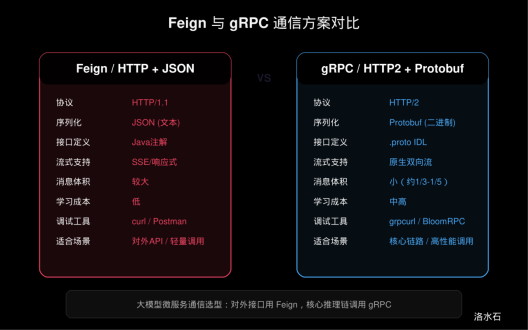
Java生态中,微服务间通信主要有两种主流方案。方案一,基于HTTP的声明式客户端Spring Cloud OpenFeign,以RESTful风格定义接口、JSON序列化数据。方案二,基于gRPC框架,使用Protocol Buffers定义接口、二进制序列化数据。两种方案各有优劣,本章将深入分析其设计原理与最佳实践。
选择通信方案时需要考量几个关键因素:数据序列化效率决定了传输带宽和CPU开销;连接复用能力影响高并发场景下的吞吐量;流式传输支持对于大模型流式输出的场景至关重要;生态集成度决定了开发效率和运维成本;类型安全保证减少运行时错误。
本文将从实际生产环境出发,结合代码示例展示如何在大模型微服务拆分场景下,合理设计和选择通信方案。
2.1 Feign基础配置与集成
Spring Cloud OpenFeign 是声明式Web服务客户端,它让编写Web服务客户端变得更简单。开发者只需创建一个接口并添加注解即可完成服务调用,无需手动构建HTTP请求。
基础依赖配置如下:
<dependency>
<groupId>org.springframework.cloud</groupId>
<artifactId>spring-cloud-starter-openfeign</artifactId>
</dependency>
启动类添加 `@EnableFeignClients` 注解激活Feign:
@SpringBootApplication
@EnableFeignClients(basePackages = "com.example.llm.client")
public class LlmGatewayApplication {
public static void main(String[] args) {
SpringApplication.run(LlmGatewayApplication.class, args);
}
}
Feign的核心配置项包括连接超时、读取超时、日志级别、编码器和解码器等。针对大模型服务调用,需要特别关注超时设置,因为推理请求的响应时间可能较长。
spring:
cloud:
openfeign:
client:
config:
llm-inference-service:
connect-timeout: 5000
read-timeout: 120000
logger-level: full
compression:
request:
enabled: true
mime-types: application/json
min-request-size: 2048
response:
enabled: true
这里将读取超时设置为120秒,因为大模型推理可能需要较长时间。同时启用请求和响应的Gzip压缩,减少网络传输的数据量。对于大模型的出入参,压缩可以显著减少带宽消耗,通常能压缩至原始大小的20%到30%。
2.2 大模型服务调用的请求封装
定义大模型推理服务的Feign接口时,需要仔细设计请求和响应对象。以下是一个典型的LLM推理服务Feign客户端示例:
@FeignClient(
name = "llm-inference-service",
url = "${llm.inference.url}",
configuration = LlmFeignConfig.class
)
public interface LlmInferenceClient {
@PostMapping("/v1/chat/completions")
ChatResponse chatCompletion(@RequestBody ChatRequest request);
@PostMapping("/v1/embeddings")
EmbeddingResponse getEmbeddings(@RequestBody EmbeddingRequest request);
@GetMapping("/v1/models")
List<ModelInfo> listModels();
}
请求对象的封装需要特别注意序列化兼容性。使用Lombok结合Jackson注解减少样板代码:
@Data
@Builder
@NoArgsConstructor
@AllArgsConstructor
@JsonInclude(JsonInclude.Include.NON_NULL)
public class ChatRequest {
private String model;
@JsonProperty("messages")
private List<ChatMessage> messages;
@JsonProperty("max_tokens")
private Integer maxTokens;
@JsonProperty("temperature")
private Double temperature;
@JsonProperty("top_p")
private Double topP;
@JsonProperty("stream")
private Boolean stream;
@JsonProperty("stop")
private List<String> stop;
}
@Data
@Builder
@NoArgsConstructor
@AllArgsConstructor
public class ChatMessage {
private String role;
private String content;
@JsonProperty("name")
@JsonInclude(JsonInclude.Include.NON_NULL)
private String name;
}
在实际调用中,通过服务层封装Feign客户端,添加业务逻辑处理。以下是一个封装了重试和降级逻辑的调用服务:
@Service
@Slf4j
public class LlmInferenceService {
private final LlmInferenceClient client;
public LlmInferenceService(LlmInferenceClient client) {
this.client = client;
}
public ChatResponse chat(String model, List<ChatMessage> messages) {
ChatRequest request = ChatRequest.builder()
.model(model)
.messages(messages)
.maxTokens(4096)
.temperature(0.7)
.build();
long start = System.currentTimeMillis();
try {
ChatResponse response = client.chatCompletion(request);
long elapsed = System.currentTimeMillis() - start;
log.info("LLM inference completed in {}ms, tokens: {}",
elapsed, response.getUsage().getTotalTokens());
return response;
} catch (FeignException e) {
log.error("LLM inference failed: status={}, message={}",
e.status(), e.getMessage());
throw new LlmServiceException("LLM调用失败", e);
}
}
}
2.3 超时与重试策略
大模型服务的超时处理与普通微服务有显著不同。普通API调用通常在秒级完成,而大模型推理可能需要数十秒甚至更长。因此,需要设计分层超时策略。
第一层是连接超时,通常设为3到5秒,超过此时间未能建立连接则快速失败。第二层是读取超时,根据模型类型和预期输出长度设置。对于生成类模型,按预估token产出速率(如每秒20到30个token)乘以最大token数计算超时时间。第三层是整体请求超时,作为兜底保护。
@Configuration
public class LlmFeignConfig {
@Bean
public Request.Options requestOptions(
@Value("${llm.client.connect-timeout:5000}") int connectTimeout,
@Value("${llm.client.read-timeout:300000}") int readTimeout) {
return new Request.Options(connectTimeout,
TimeUnit.MILLISECONDS, readTimeout, TimeUnit.MILLISECONDS, true);
}
@Bean
public Retryer retryer() {
// 大模型调用重试需谨慎,避免重复消费
return new Retryer.Default(1000, 2000, 2);
}
}
重试策略需要格外谨慎。大模型请求可能已经部分执行,重试可能导致重复消费token或产生副作用。建议仅对连接超时和5xx服务器错误进行重试,对4xx客户端错误和读取超时不重试。可以通过自定义重试器实现:
public class LlmRetryer implements Retryer {
private final int maxAttempts;
private int attempt = 0;
public LlmRetryer(int maxAttempts) {
this.maxAttempts = maxAttempts;
}
@Override
public void continueOrPropagate(RetryableException e) {
if (++attempt > maxAttempts) {
throw e;
}
if (e.status() >= 400 && e.status() < 500) {
throw e; // 客户端错误不重试
}
long interval = (long) Math.pow(2, attempt) * 1000L;
try {
Thread.sleep(interval);
} catch (InterruptedException ie) {
Thread.currentThread().interrupt();
throw e;
}
}
@Override
public Retryer clone() {
return new LlmRetryer(maxAttempts);
}
}
3.1 Protobuf定义与代码生成
gRPC基于Protocol Buffers作为接口定义语言和底层消息交换格式。在定义大模型服务的gRPC接口前,需要设计合理的Protobuf消息结构。以下是LLM推理服务的proto定义示例:
syntax = "proto3";
package com.example.llm.grpc;
option java_multiple_files = true;
option java_package = "com.example.llm.grpc.proto";
service LlmInferenceService {
// 单次对话补全
rpc ChatCompletion(ChatRequest) returns (ChatResponse);
// 流式对话补全(服务端流)
rpc StreamChatCompletion(ChatRequest) returns (stream ChatStreamChunk);
// 批量嵌入
rpc GetEmbeddings(EmbeddingRequest) returns (EmbeddingResponse);
// 获取模型信息
rpc ListModels(ListModelsRequest) returns (ListModelsResponse);
}
message ChatRequest {
string model = 1;
repeated ChatMessage messages = 2;
int32 max_tokens = 3;
double temperature = 4;
double top_p = 5;
repeated string stop = 6;
}
message ChatMessage {
string role = 1;
string content = 2;
}
message ChatResponse {
string id = 1;
string model = 2;
repeated Choice choices = 3;
Usage usage = 4;
}
message Choice {
int32 index = 1;
ChatMessage message = 2;
string finish_reason = 3;
}
message ChatStreamChunk {
string id = 1;
string model = 2;
repeated StreamChoice choices = 3;
}
message StreamChoice {
int32 index = 1;
ChatMessage delta = 2;
string finish_reason = 3;
}
message Usage {
int32 prompt_tokens = 1;
int32 completion_tokens = 2;
int32 total_tokens = 3;
}
Proto文件的编译依赖于protobuf-maven-plugin:
<plugin>
<groupId>org.xolstice.maven.plugins</groupId>
<artifactId>protobuf-maven-plugin</artifactId>
<version>0.6.1</version>
<configuration>
<protocArtifact>com.google.protobuf:protoc:3.21.7:exe:${os.detected.classifier}</protocArtifact>
<pluginId>grpc-java</pluginId>
<pluginArtifact>io.grpc:protoc-gen-grpc-java:1.54.0:exe:${os.detected.classifier}</pluginArtifact>
</configuration>
<executions>
<execution>
<goals>
<goal>compile</goal>
<goal>compile-custom</goal>
</goals>
</execution>
</executions>
</plugin>
执行 `mvn compile` 后,target目录下会生成对应的Java类,包括消息类和gRPC Stub类。
3.2 大模型服务的gRPC服务端实现
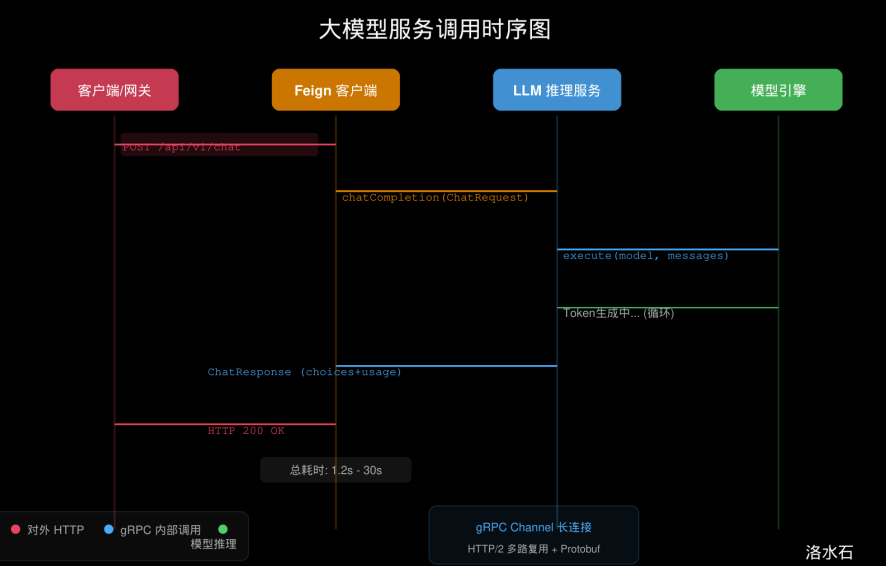
gRPC服务端需要继承生成的基类并实现抽象方法。以下是大模型推理服务的gRPC服务端实现:
@GrpcService
@Slf4j
public class LlmInferenceGrpcService
extends LlmInferenceServiceGrpc.LlmInferenceServiceImplBase {
private final ModelExecutor modelExecutor;
public LlmInferenceGrpcService(ModelExecutor modelExecutor) {
this.modelExecutor = modelExecutor;
}
@Override
public void chatCompletion(ChatRequest request,
StreamObserver<ChatResponse> responseObserver) {
try {
List<Message> messages = convertToInternalMessages(request.getMessagesList());
CompletionResult result = modelExecutor.execute(
request.getModel(), messages, request.getMaxTokens(),
request.getTemperature(), request.getTopP());
ChatResponse response = buildResponse(result);
responseObserver.onNext(response);
responseObserver.onCompleted();
} catch (Exception e) {
log.error("gRPC chat completion failed", e);
responseObserver.onError(Status.INTERNAL
.withDescription(e.getMessage()).asRuntimeException());
}
}
@Override
public void streamChatCompletion(ChatRequest request,
StreamObserver<ChatStreamChunk> responseObserver) {
List<Message> messages = convertToInternalMessages(request.getMessagesList());
modelExecutor.executeStream(request.getModel(), messages,
request.getMaxTokens(), request.getTemperature(), request.getTopP(),
new StreamCallback() {
@Override
public void onToken(String token, int index) {
ChatStreamChunk chunk = ChatStreamChunk.newBuilder()
.setId(UUID.randomUUID().toString())
.setModel(request.getModel())
.addChoices(StreamChoice.newBuilder()
.setIndex(index)
.setDelta(ChatMessage.newBuilder()
.setRole("assistant")
.setContent(token)
.build())
.build())
.build();
responseObserver.onNext(chunk);
}
@Override
public void onComplete(String finishReason) {
responseObserver.onCompleted();
}
@Override
public void onError(Throwable t) {
responseObserver.onError(Status.INTERNAL
.withDescription(t.getMessage()).asRuntimeException());
}
});
}
}
服务端的拦截器可以统一处理认证、日志、限流等横切关注点:
@GrpcGlobalInterceptor
public class GrpcLoggingInterceptor implements ServerInterceptor {
@Override
public <ReqT, RespT> ServerCall.Listener<ReqT> interceptCall(
ServerCall<ReqT, RespT> call, Metadata headers,
ServerCallHandler<ReqT, RespT> next) {
String method = call.getMethodDescriptor().getFullMethodName();
long startTime = System.currentTimeMillis();
ServerCall.Listener<ReqT> listener = next.startCall(
new ForwardingServerCall.SimpleForwardingServerCall<ReqT, RespT>(call) {
@Override
public void close(Status status, Metadata trailers) {
long elapsed = System.currentTimeMillis() - startTime;
log.info("gRPC {} completed: status={}, elapsed={}ms",
method, status.getCode(), elapsed);
super.close(status, trailers);
}
}, headers);
return new ForwardingServerCallListener
.SimpleForwardingServerCallListener<ReqT>(listener) {};
}
}
3.3 gRPC客户端调用与负载均衡
gRPC客户端通过Stub进行调用。针对大模型服务,需要配置合适的通道属性和负载均衡策略:
@Configuration
public class GrpcClientConfig {
@Bean
public ManagedChannel managedChannel(
@Value("${grpc.client.llm-inference.host:localhost}") String host,
@Value("${grpc.client.llm-inference.port:9090}") int port) {
return ManagedChannelBuilder.forAddress(host, port)
.usePlaintext()
.maxInboundMessageSize(16 * 1024 * 1024) // 16MB,支持大响应
.keepAliveTime(30, TimeUnit.SECONDS)
.keepAliveTimeout(10, TimeUnit.SECONDS)
.keepAliveWithoutCalls(true)
.enableRetry()
.defaultServiceConfig(buildRetryConfig())
.build();
}
@Bean
public LlmInferenceServiceGrpc.LlmInferenceServiceStub
asyncStub(ManagedChannel channel) {
return LlmInferenceServiceGrpc.newStub(channel)
.withDeadlineAfter(300, TimeUnit.SECONDS)
.withWaitForReady();
}
private Map<String, Object> buildRetryConfig() {
Map<String, Object> retryPolicy = new HashMap<>();
retryPolicy.put("maxAttempts", 3);
retryPolicy.put("initialBackoff", "1s");
retryPolicy.put("maxBackoff", "10s");
retryPolicy.put("backoffMultiplier", 2.0);
retryPolicy.put("retryableStatusCodes",
Arrays.asList("UNAVAILABLE", "DEADLINE_EXCEEDED"));
Map<String, Object> methodConfig = new HashMap<>();
methodConfig.put("name", Collections.singletonList(
Collections.singletonMap("service", "com.example.llm.grpc.LlmInferenceService")));
methodConfig.put("retryPolicy", retryPolicy);
return Collections.singletonMap("methodConfig",
Collections.singletonList(methodConfig));
}
}
在多实例场景下,需要配置客户端负载均衡。可以通过服务发现与NameResolver结合实现:
ManagedChannel channel = ManagedChannelBuilder.forTarget("dns:///llm-inference.internal:9090")
.defaultLoadBalancingPolicy("round_robin")
.usePlaintext()
.build();
异步调用的典型用法:
@Service
public class GrpcLlmClient {
private final LlmInferenceServiceGrpc.LlmInferenceServiceStub asyncStub;
private final LlmInferenceServiceGrpc.LlmInferenceServiceBlockingStub blockingStub;
public CompletableFuture<ChatResponse> chatCompletionAsync(ChatRequest request) {
CompletableFuture<ChatResponse> future = new CompletableFuture<>();
StreamObserver<ChatResponse> observer =
new StreamObserver<ChatResponse>() {
@Override
public void onNext(ChatResponse response) {
future.complete(response);
}
@Override
public void onError(Throwable t) {
future.completeExceptionally(t);
}
@Override
public void onCompleted() {}
};
asyncStub.chatCompletion(request, observer);
return future.orTimeout(300, TimeUnit.SECONDS);
}
}
4.1 性能对比
在序列化效率上,gRPC的Protocol Buffers二进制序列化体积约为JSON文本序列化的三分之一到五分之一。对于大模型场景下包含大量文本的请求响应,这一差距更为显著。gRPC使用HTTP/2作为传输协议,支持多路复用、头部压缩和服务器推送,在高并发场景下有明显优势。
下表反映了典型的性能差异:
|
指标 |
Feign/HTTP+JSON |
gRPC/HTTP2+Protobuf |
|
------ |
---------------- |
------------------- |
|
序列化速度 |
中等 |
快(约3-5倍) |
|
消息体积 |
大(基准) |
小(约1/3-1/5) |
|
连接开销 |
高(HTTP/1.1) |
低(HTTP/2多路复用) |
|
单次RTT |
2-10ms |
1-3ms |
|
并发1000请求 |
需大量连接 |
单连接即可 |
在1000并发请求的压测中,gRPC通常比Feign的吞吐量高2到3倍,延迟降低40%到60%。对于大模型推理这类计算密集型、响应体较大的场景,gRPC的性能优势尤为突出。
4.2 可维护性对比
Feign的优势在于直观易懂。接口定义使用Java注解,开发者无需学习额外的IDL语言。与Spring生态深度集成,支持断路器、负载均衡、服务发现等组件。调试方便,HTTP请求可通过curl、Postman等工具直接测试。
gRPC虽然性能优异,但学习成本较高。开发者需要掌握Proto3语法和gRPC的服务定义方式。调试相对复杂,需要专用工具如grpcurl或BloomRPC。但gRPC提供的强类型接口定义是一把双刃剑:在编译期就能发现接口不匹配问题,减少了生产环境的运行时错误。
从版本演进角度看,Protobuf的向后兼容机制比JSON更加成熟和可控。通过字段编号和默认值,可以在不破坏旧客户端的情况下添加新字段。这对于微服务独立演进的场景至关重要。
4.3 适用场景分析
根据实践经验,以下场景更适合使用Feign:
第一,对外暴露的API网关层。RESTful API是业界通用的接口风格,第三方集成和前端调用都更自然。
第二,请求响应体较小(小于100KB)的同步调用。如用户认证、配置查询等辅助服务。
第三,团队对gRPC经验不足,追求快速交付的早期阶段。可以先使用Feign快速搭建,后期根据性能需求逐步迁移热路径到gRPC。
以下场景更适合使用gRPC:
第一,大模型推理服务等对性能敏感的核心链路上的调用。推理请求的Payload可能包含完整对话历史,响应包含了大量生成文本。
第二,需要服务端流式推送的场景。虽然Feign也可以通过响应式方式模拟,但gRPC原生支持服务端流、客户端流和双向流,实现更加自然。
第三,内部微服务间的高频、高并发调用。HTTP/2多路复用可以避免HTTP/1.1的连接池瓶颈。
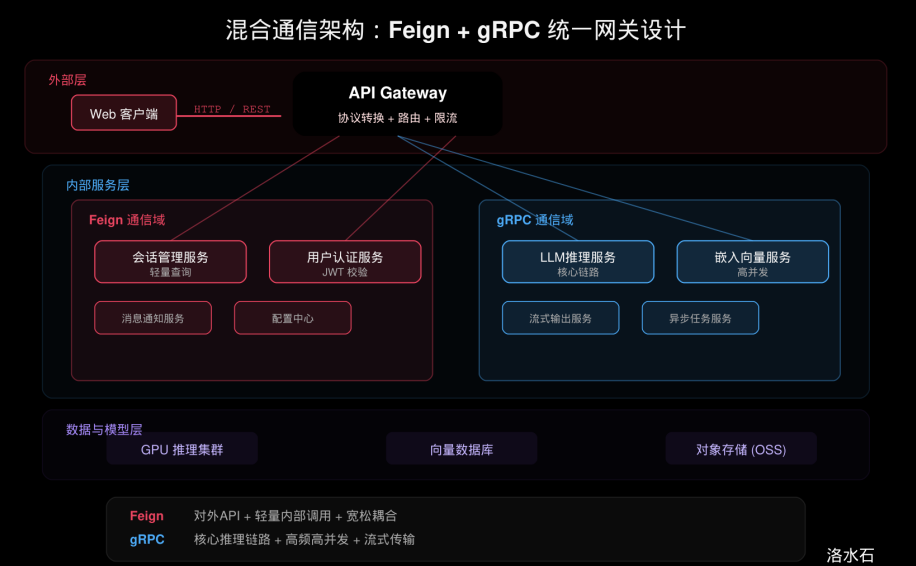
在实际的大模型微服务架构中,往往不会一刀切地选择单一通信方式,而是采用混合架构。外部流量走REST API进入网关,网关内部根据调用特点选择不同的通信协议。
典型的混合架构如下:API网关对外暴露RESTful接口,接收客户端请求。网关内部的轻量级查询(如用户信息、会话状态)通过Feign调用对应服务。核心的模型推理请求通过gRPC调用推理服务集群,充分利用HTTP/2的多路复用和二进制序列化优势。对于流式输出场景,gRPC服务端流或专门的WebSocket通道处理实时推送。
混合架构的实现中,网关层负责协议转换:
@RestController
@RequestMapping("/api/v1")
public class LlmGatewayController {
private final GrpcLlmClient grpcClient;
private final RestLlmClient restClient;
public LlmGatewayController(GrpcLlmClient grpcClient, RestLlmClient restClient) {
this.grpcClient = grpcClient;
this.restClient = restClient;
}
@PostMapping("/chat/completions")
public ChatResponse chatCompletion(@RequestBody ChatApiRequest apiRequest) {
// 将REST请求转换为内部格式
ChatRequest grpcRequest = convertToGrpcRequest(apiRequest);
// 根据模型类型路由到不同的后端
if (isHighPerformanceModel(apiRequest.getModel())) {
return convertFromGrpc(grpcClient.chatCompletionSync(grpcRequest));
} else {
return restClient.chatCompletion(apiRequest);
}
}
@PostMapping("/chat/completions/stream")
public Flux<ServerSentEvent<ChatStreamChunk>> streamChatCompletion(
@RequestBody ChatApiRequest apiRequest) {
return Flux.create(sink -> {
StreamObserver<ChatStreamChunk> observer =
new StreamObserver<ChatStreamChunk>() {
@Override
public void onNext(ChatStreamChunk chunk) {
sink.next(ServerSentEvent.builder(chunk).build());
}
@Override
public void onError(Throwable t) {
sink.error(t);
}
@Override
public void onCompleted() {
sink.complete();
}
};
ChatRequest grpcRequest = convertToGrpcRequest(apiRequest);
asyncStub.streamChatCompletion(grpcRequest, observer);
});
}
}
这种混合架构兼顾了外部兼容性和内部性能,是一种务实的设计选择。
在大模型微服务调用链中,任何一个环节的失败都可能导致用户体验受损。因此需要建立完善的容错与降级机制。
使用Resilience4j实现断路器模式:
@FeignClient(
name = "llm-inference-service",
fallbackFactory = LlmInferenceFallbackFactory.class
)
public interface LlmInferenceClient {
@PostMapping("/v1/chat/completions")
ChatResponse chatCompletion(@RequestBody ChatRequest request);
}
@Component
public class LlmInferenceFallbackFactory
implements FallbackFactory<LlmInferenceClient> {
@Override
public LlmInferenceClient create(Throwable cause) {
return new LlmInferenceClient() {
@Override
public ChatResponse chatCompletion(ChatRequest request) {
log.warn("LLM inference degraded, using fallback", cause);
return ChatResponse.builder()
.content("抱歉,当前服务繁忙,请稍后重试。")
.model(request.getModel())
.fallback(true)
.build();
}
};
}
}
结合Resilience4j的断路器配置:
resilience4j:
circuitbreaker:
instances:
llm-inference:
sliding-window-size: 10
minimum-number-of-calls: 5
failure-rate-threshold: 50
wait-duration-in-open-state: 30s
permitted-number-of-calls-in-half-open-state: 3
retry:
instances:
llm-inference:
max-attempts: 3
wait-duration: 1s
retry-exceptions:
- java.net.ConnectException
- java.net.SocketTimeoutException
对于gRPC的容错,可以利用gRPC内置的重试机制结合应用层断路器:
@Service
public class ResilientGrpcClient {
private final CircuitBreaker circuitBreaker;
private final LlmInferenceServiceGrpc.LlmInferenceServiceBlockingStub stub;
public ResilientGrpcClient(
CircuitBreakerRegistry registry,
LlmInferenceServiceGrpc.LlmInferenceServiceBlockingStub stub) {
this.circuitBreaker = registry.circuitBreaker("grpc-llm");
this.stub = stub;
}
public ChatResponse chatCompletion(ChatRequest request) {
return circuitBreaker.executeSupplier(() -> {
try {
return stub.chatCompletion(request);
} catch (StatusRuntimeException e) {
if (e.getStatus().getCode() == Status.Code.UNAVAILABLE) {
throw new UnavailableException("gRPC service unavailable", e);
}
throw new RuntimeException(e);
}
});
}
}
在大模型微服务拆分场景下,通信方案选择是架构决策中的关键一环。本章系统介绍了Feign和gRPC两种方案的设计原理、实现方式与适用场景。
核心要点概括如下。第一,Feign适合对外接口和内部轻量调用,开发效率高、生态成熟。第二,gRPC适合性能敏感的核心链路调用,序列化效率高、支持多路复用和原生流式传输。第三,混合架构是实践中常见的选择,通过网关层协议转换兼顾内外需求。第四,容错机制是必要的保障,断路器、重试和降级策略需要结合大模型调用特点精细设计。
在下一章中,我们将讨论异步任务服务的设计,探讨如何将长时推理任务从同步调用中解耦出来,通过消息队列实现任务的异步处理和回调通知。

欢迎加入 MCP 技术社区!与志同道合者携手前行,一同解锁 MCP 技术的无限可能!
更多推荐
 4
4 0
0- 0


 已为社区贡献11条内容

所有评论(0)