给kali加个MCP,直接用trace做渗透测试
·
原理及使用
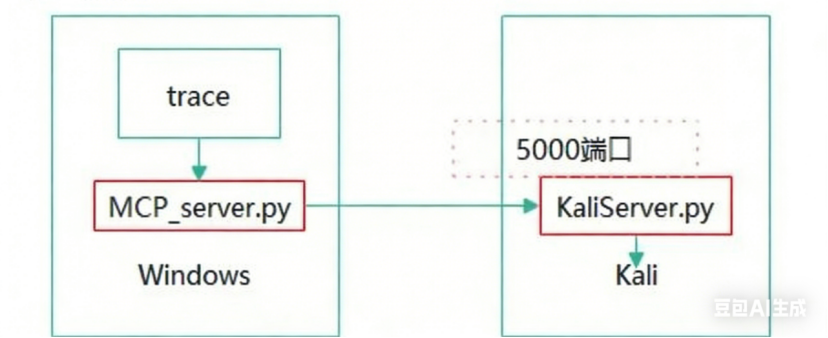
系统整体实现就是两个python文件,一个是kali_server.py,在Kali上运行,将Kali的功能封装成API,并启动5000端口监听,几乎所有的Kali工具都可以调用。另一个是mcp_server.py,运行在本地,可以直接与trace对接
注意
mcp_server.py中的修改

Mcp_server.py
#!/usr/bin/env python3

# This script connect the MCP AI agent to Kali Linux terminal and API Server.

# some of the code here was inspired from https://github.com/whit3rabbit0/project_astro , be sure to check them out

import sys
import os
import argparse
import logging
from typing import Dict, Any, Optional, List, Union
import requests

from mcp.server.fastmcp import FastMCP

# Configure logging
logging.basicConfig(
    level=logging.INFO,
    format="%(asctime)s [%(levelname)s] %(message)s",
    handlers=[
        logging.StreamHandler(sys.stdout)
    ]
)
logger = logging.getLogger(__name__)

# Default configuration
DEFAULT_KALI_SERVER = "http://192.168.236.128:5000" # change to your linux IP
DEFAULT_REQUEST_TIMEOUT = 300  # 5 minutes default timeout for API requests

class KaliToolsClient:
    """Client for communicating with the Kali Linux Tools API Server"""

    def __init__(self, server_url: str, timeout: int = DEFAULT_REQUEST_TIMEOUT):
        """
        Initialize the Kali Tools Client

        Args:
            server_url: URL of the Kali Tools API Server
            timeout: Request timeout in seconds
        """
        self.server_url = server_url.rstrip("/")
        self.timeout = timeout
        logger.info(f"Initialized Kali Tools Client connecting to {server_url}")

    def safe_get(self, endpoint: str, params: Optional[Dict[str, Any]] = None) -> Dict[str, Any]:
        """
        Perform a GET request with optional query parameters.

        Args:
            endpoint: API endpoint path (without leading slash)
            params: Optional query parameters

        Returns:
            Response data as dictionary
        """
        if params is None:
            params = {}

        url = f"{self.server_url}/{endpoint}"

        try:
            logger.debug(f"GET {url} with params: {params}")
            response = requests.get(url, params=params, timeout=self.timeout)
            response.raise_for_status()
            return response.json()
        except requests.exceptions.RequestException as e:
            logger.error(f"Request failed: {str(e)}")
            return {"error": f"Request failed: {str(e)}", "success": False}
        except Exception as e:
            logger.error(f"Unexpected error: {str(e)}")
            return {"error": f"Unexpected error: {str(e)}", "success": False}

    def safe_post(self, endpoint: str, json_data: Dict[str, Any]) -> Dict[str, Any]:
        """
        Perform a POST request with JSON data.

        Args:
            endpoint: API endpoint path (without leading slash)
            json_data: JSON data to send

        Returns:
            Response data as dictionary
        """
        url = f"{self.server_url}/{endpoint}"

        try:
            logger.debug(f"POST {url} with data: {json_data}")
            response = requests.post(url, json=json_data, timeout=self.timeout)
            response.raise_for_status()
            return response.json()
        except requests.exceptions.RequestException as e:
            logger.error(f"Request failed: {str(e)}")
            return {"error": f"Request failed: {str(e)}", "success": False}
        except Exception as e:
            logger.error(f"Unexpected error: {str(e)}")
            return {"error": f"Unexpected error: {str(e)}", "success": False}

    def execute_command(self, command: str, interactive: bool = False) -> Dict[str, Any]:
        """
        Execute a generic command on the Kali server

        Args:
            command: Command to execute
            interactive: Whether the command requires interactive mode

        Returns:
            Command execution results
        """
        return self.safe_post("api/command", {"command": command, "interactive": interactive})

    def execute_interactive_tool(self, tool: str, commands: List[str] = None, timeout: int = None) -> Dict[str, Any]:
        """
        Execute an interactive tool with a sequence of commands

        Args:
            tool: The tool to execute (e.g., msfconsole, sqlmap)
            commands: List of commands to execute in the interactive session
            timeout: Custom timeout for this interactive session

        Returns:
            Interactive session results
        """
        data = {
            "command": tool,
            "interactive": True
        }

        if timeout is not None:
            data["timeout"] = timeout

        return self.safe_post("api/command", data)

    def check_health(self) -> Dict[str, Any]:
        """
        Check the health of the Kali Tools API Server

        Returns:
            Health status information
        """
        return self.safe_get("health")

def setup_mcp_server(kali_client: KaliToolsClient) -> FastMCP:
    """
    Set up the MCP server with all tool functions

    Args:
        kali_client: Initialized KaliToolsClient

    Returns:
        Configured FastMCP instance
    """
    mcp = FastMCP("kali-mcp")

    @mcp.tool()
    def nmap_scan(target: str, scan_type: str = "-sV", ports: str = "", additional_args: str = "") -> Dict[str, Any]:
        """
        Execute an Nmap scan against a target.

        Args:
            target: The IP address or hostname to scan
            scan_type: Scan type (e.g., -sV for version detection)
            ports: Comma-separated list of ports or port ranges
            additional_args: Additional Nmap arguments

        Returns:
            Scan results
        """
        data = {
            "target": target,
            "scan_type": scan_type,
            "ports": ports,
            "additional_args": additional_args
        }
        return kali_client.safe_post("api/tools/nmap", data)

    @mcp.tool()
    def gobuster_scan(url: str, mode: str = "dir", wordlist: str = "/usr/share/wordlists/dirb/common.txt", additional_args: str = "") -> Dict[str, Any]:
        """
        Execute Gobuster to find directories, DNS subdomains, or virtual hosts.

        Args:
            url: The target URL
            mode: Scan mode (dir, dns, fuzz, vhost)
            wordlist: Path to wordlist file
            additional_args: Additional Gobuster arguments

        Returns:
            Scan results
        """
        data = {
            "url": url,
            "mode": mode,
            "wordlist": wordlist,
            "additional_args": additional_args
        }
        return kali_client.safe_post("api/tools/gobuster", data)

    @mcp.tool()
    def dirb_scan(url: str, wordlist: str = "/usr/share/wordlists/dirb/common.txt", additional_args: str = "") -> Dict[str, Any]:
        """
        Execute Dirb web content scanner.

        Args:
            url: The target URL
            wordlist: Path to wordlist file
            additional_args: Additional Dirb arguments

        Returns:
            Scan results
        """
        data = {
            "url": url,
            "wordlist": wordlist,
            "additional_args": additional_args
        }
        return kali_client.safe_post("api/tools/dirb", data)

    @mcp.tool()
    def nikto_scan(target: str, additional_args: str = "") -> Dict[str, Any]:
        """
        Execute Nikto web server scanner.

        Args:
            target: The target URL or IP
            additional_args: Additional Nikto arguments

        Returns:
            Scan results
        """
        data = {
            "target": target,
            "additional_args": additional_args
        }
        return kali_client.safe_post("api/tools/nikto", data)

    @mcp.tool()
    def sqlmap_scan(url: str, data: str = "", additional_args: str = "") -> Dict[str, Any]:
        """
        Execute SQLmap SQL injection scanner.

        Args:
            url: The target URL
            data: POST data string
            additional_args: Additional SQLmap arguments

        Returns:
            Scan results
        """
        post_data = {
            "url": url,
            "data": data,
            "additional_args": additional_args
        }
        return kali_client.safe_post("api/tools/sqlmap", post_data)


    @mcp.tool()
    def msfconsole_interactive(resource_script: str = None, commands: List[str] = None, timeout: int = None) -> Dict[str, Any]:
        """
        Start an interactive Metasploit console session.

        Args:
            resource_script: Optional path to MSF resource script
            commands: List of commands to execute in MSF console
            timeout: Custom timeout for this MSF console session

        Returns:
            MSF console session results
        """
        base_command = "msfconsole -q"

        if resource_script:
            if not os.path.exists(resource_script):
                return {
                    "error": f"Resource script file not found: {resource_script}",
                    "success": False
                }
            base_command += f" -r {resource_script}"

        # Create a temporary resource script if commands are provided
        temp_resource_file = None
        if commands and not resource_script:
            try:
                import tempfile
                temp_resource_file = tempfile.NamedTemporaryFile(delete=False, mode='w+', suffix='.rc')
                for cmd in commands:
                    temp_resource_file.write(f"{cmd}\n")
                temp_resource_file.close()
                base_command += f" -r {temp_resource_file.name}"
            except Exception as e:
                logger.error(f"Error creating temporary resource file: {str(e)}")
                return {
                    "error": f"Failed to create resource script: {str(e)}",
                    "success": False
                }

        try:
            result = kali_client.execute_command(base_command, interactive=True)

            # Clean up temporary file if created
            if temp_resource_file and os.path.exists(temp_resource_file.name):
                try:
                    os.unlink(temp_resource_file.name)
                except:
                    pass

            return result
        except Exception as e:
            logger.error(f"Error in msfconsole interactive: {str(e)}")

            # Clean up on error too
            if temp_resource_file and os.path.exists(temp_resource_file.name):
                try:
                    os.unlink(temp_resource_file.name)
                except:
                    pass

            return {
                "error": f"MSF console execution failed: {str(e)}",
                "success": False
            }

    @mcp.tool()
    def hydra_attack(
        target: str,
        service: str,
        username: str = "",
        username_file: str = "",
        password: str = "",
        password_file: str = "",
        additional_args: str = ""
    ) -> Dict[str, Any]:
        """
        Execute Hydra password cracking tool.

        Args:
            target: Target IP or hostname
            service: Service to attack (ssh, ftp, http-post-form, etc.)
            username: Single username to try
            username_file: Path to username file
            password: Single password to try
            password_file: Path to password file
            additional_args: Additional Hydra arguments

        Returns:
            Attack results
        """
        data = {
            "target": target,
            "service": service,
            "username": username,
            "username_file": username_file,
            "password": password,
            "password_file": password_file,
            "additional_args": additional_args
        }
        return kali_client.safe_post("api/tools/hydra", data)

    @mcp.tool()
    def john_crack(
        hash_file: str,
        wordlist: str = "/usr/share/wordlists/rockyou.txt",
        format_type: str = "",
        additional_args: str = ""
    ) -> Dict[str, Any]:
        """
        Execute John the Ripper password cracker.

        Args:
            hash_file: Path to file containing hashes
            wordlist: Path to wordlist file
            format_type: Hash format type
            additional_args: Additional John arguments

        Returns:
            Cracking results
        """
        data = {
            "hash_file": hash_file,
            "wordlist": wordlist,
            "format": format_type,
            "additional_args": additional_args
        }
        return kali_client.safe_post("api/tools/john", data)

    @mcp.tool()
    def wpscan_analyze(url: str, additional_args: str = "") -> Dict[str, Any]:
        """
        Execute WPScan WordPress vulnerability scanner.

        Args:
            url: The target WordPress URL
            additional_args: Additional WPScan arguments

        Returns:
            Scan results
        """
        data = {
            "url": url,
            "additional_args": additional_args
        }
        return kali_client.safe_post("api/tools/wpscan", data)

    @mcp.tool()
    def enum4linux_scan(target: str, additional_args: str = "-a") -> Dict[str, Any]:
        """
        Execute Enum4linux Windows/Samba enumeration tool.

        Args:
            target: The target IP or hostname
            additional_args: Additional enum4linux arguments

        Returns:
            Enumeration results
        """
        data = {
            "target": target,
            "additional_args": additional_args
        }
        return kali_client.safe_post("api/tools/enum4linux", data)

    @mcp.tool()
    def server_health() -> Dict[str, Any]:
        """
        Check the health status of the Kali API server.

        Returns:
            Server health information
        """
        return kali_client.check_health()

    @mcp.tool()
    def execute_command(command: str, interactive: bool = False) -> Dict[str, Any]:
        """
        Execute an arbitrary command on the Kali server.

        Args:
            command: The command to execute
            interactive: Whether the command requires interactive mode

        Returns:
            Command execution results
        """
        return kali_client.execute_command(command, interactive)

    @mcp.tool()
    def run_interactive(tool: str, commands: List[str] = None, timeout: int = None) -> Dict[str, Any]:
        """
        Run a tool in interactive mode.

        Args:
            tool: The tool to run (e.g., msfconsole, sqlmap, hydra)
            commands: List of commands to send to the interactive session
            timeout: Custom timeout for this interactive session

        Returns:
            Interactive session results
        """
        # Special handling for known interactive tools
        if tool.startswith("msfconsole"):
            return msfconsole_interactive(commands=commands, timeout=timeout)
        elif tool.startswith("sqlmap"):
            # Add --batch to make it non-interactive but still use the interactive executor
            if not "--batch" in tool:
                tool += " --batch"

        return kali_client.execute_interactive_tool(tool, commands, timeout)

    @mcp.tool()
    def sql_interactive(url: str, data: str = "", commands: List[str] = None, timeout: int = None) -> Dict[str, Any]:
        """
        Run SQLMap in interactive mode with more options.

        Args:
            url: Target URL
            data: Optional POST data
            commands: Additional SQLMap commands/options
            timeout: Custom timeout for this session

        Returns:
            SQLMap session results
        """
        command = f"sqlmap -u {url} --batch"

        if data:
            command += f" --data=\"{data}\""

        return kali_client.execute_command(command, interactive=True)

    @mcp.tool()
    def create_metasploit_resource(commands: List[str], output_file: str) -> Dict[str, Any]:
        """
        Create a Metasploit resource script.

        Args:
            commands: List of MSF commands to include in the script
            output_file: Path to save the resource script

        Returns:
            Result of script creation
        """
        try:
            with open(output_file, 'w') as f:
                for cmd in commands:
                    f.write(f"{cmd}\n")

            return {
                "success": True,
                "message": f"Created Metasploit resource script at {output_file}",
                "file": output_file
            }
        except Exception as e:
            logger.error(f"Error creating resource script: {str(e)}")
            return {
                "success": False,
                "error": f"Failed to create resource script: {str(e)}"
            }

    return mcp

def parse_args():
    """Parse command line arguments."""
    parser = argparse.ArgumentParser(description="Run the Kali MCP Client")
    parser.add_argument("--server", type=str, default=DEFAULT_KALI_SERVER,
                      help=f"Kali API server URL (default: {DEFAULT_KALI_SERVER})")
    parser.add_argument("--timeout", type=int, default=DEFAULT_REQUEST_TIMEOUT,
                      help=f"Request timeout in seconds (default: {DEFAULT_REQUEST_TIMEOUT})")
    parser.add_argument("--debug", action="store_true", help="Enable debug logging")
    return parser.parse_args()

def main():
    """Main entry point for the MCP server."""
    args = parse_args()

    # Configure logging based on debug flag
    if args.debug:
        logger.setLevel(logging.DEBUG)
        logger.debug("Debug logging enabled")

    # Initialize the Kali Tools client
    kali_client = KaliToolsClient(args.server, args.timeout)

    # Check server health and log the result
    health = kali_client.check_health()
    if "error" in health:
        logger.warning(f"Unable to connect to Kali API server at {args.server}: {health['error']}")
        logger.warning("MCP server will start, but tool execution may fail")
    else:
        logger.info(f"Successfully connected to Kali API server at {args.server}")
        logger.info(f"Server health status: {health['status']}")
        if not health.get("all_essential_tools_available", False):
            logger.warning("Not all essential tools are available on the Kali server")
            missing_tools = [tool for tool, available in health.get("tools_status", {}).items() if not available]
            if missing_tools:
                logger.warning(f"Missing tools: {', '.join(missing_tools)}")

    # Set up and run the MCP server
    mcp = setup_mcp_server(kali_client)
    logger.info("Starting Kali MCP server")
    mcp.run()

if __name__ == "__main__":
    main()
Kali_server.py
#!/usr/bin/env python3
# This script connect the MCP AI agent to Kali Linux terminal and API Server.
import argparse
import json
import logging
import os
import subprocess
import sys
import traceback
import threading
import tempfile
import signal
import time
from typing import Dict, Any, Optional, Tuple
from flask import Flask, request, jsonify
# Configure logging
logging.basicConfig(
level=logging.INFO,
format="%(asctime)s [%(levelname)s] %(message)s",
handlers=[
logging.StreamHandler(sys.stdout)
]
)
logger = logging.getLogger(__name__)
# Configuration
API_PORT = int(os.environ.get("API_PORT", 5000))
DEBUG_MODE = os.environ.get("DEBUG_MODE", "0").lower() in ("1", "true", "yes", "y")
COMMAND_TIMEOUT = 180 # 3 minutes default timeout
app = Flask(__name__)
class CommandExecutor:
"""Class to handle command execution with better timeout management"""
def __init__(self, command: str, timeout: int = COMMAND_TIMEOUT, interactive: bool = False):
self.command = command
self.timeout = timeout
self.process = None
self.stdout_data = ""
self.stderr_data = ""
self.stdout_thread = None
self.stderr_thread = None
self.return_code = None
self.timed_out = False
self.interactive = interactive
# Check if expect is installed - needed for complex interactive commands
if self.interactive and "expect" in command:
try:
check_expect = subprocess.run(["which", "expect"],
stdout=subprocess.PIPE,
stderr=subprocess.PIPE)
if check_expect.returncode != 0:
logger.warning("'expect' command not found, installing it...")
# Try to install expect
install_cmd = subprocess.run(["apt-get", "install", "-y", "expect"],
stdout=subprocess.PIPE,
stderr=subprocess.PIPE)
if install_cmd.returncode != 0:
logger.error("Failed to install 'expect'. Some interactive commands may not work properly.")
except Exception as e:
logger.error(f"Error checking/installing 'expect': {str(e)}")
def _read_stdout(self):
"""Thread function to continuously read stdout"""
for line in iter(self.process.stdout.readline, ''):
self.stdout_data += line
if DEBUG_MODE:
logger.debug(f"STDOUT: {line.strip()}")
def _read_stderr(self):
"""Thread function to continuously read stderr"""
for line in iter(self.process.stderr.readline, ''):
self.stderr_data += line
if DEBUG_MODE:
logger.debug(f"STDERR: {line.strip()}")
def execute(self) -> Dict[str, Any]:
"""Execute the command and handle timeout gracefully"""
logger.info(f"Executing command: {self.command}")
# For interactive tools, use a different approach with pseudo-TTY
if self.interactive:
return self._execute_interactive()
else:
return self._execute_non_interactive()
def _execute_non_interactive(self) -> Dict[str, Any]:
"""Execute non-interactive command"""
try:
self.process = subprocess.Popen(
self.command,
shell=True,
stdout=subprocess.PIPE,
stderr=subprocess.PIPE,
text=True,
bufsize=1 # Line buffered
)
# Start threads to read output continuously
self.stdout_thread = threading.Thread(target=self._read_stdout)
self.stderr_thread = threading.Thread(target=self._read_stderr)
self.stdout_thread.daemon = True
self.stderr_thread.daemon = True
self.stdout_thread.start()
self.stderr_thread.start()
# Wait for the process to complete or timeout
try:
self.return_code = self.process.wait(timeout=self.timeout)
# Process completed, join the threads
self.stdout_thread.join()
self.stderr_thread.join()
except subprocess.TimeoutExpired:
# Process timed out but we might have partial results
self.timed_out = True
logger.warning(f"Command timed out after {self.timeout} seconds. Terminating process.")
# Try to terminate gracefully first
self.process.terminate()
try:
self.process.wait(timeout=5) # Give it 5 seconds to terminate
except subprocess.TimeoutExpired:
# Force kill if it doesn't terminate
logger.warning("Process not responding to termination. Killing.")
self.process.kill()
# Update final output
self.return_code = -1
# Always consider it a success if we have output, even with timeout
success = True if self.timed_out and (self.stdout_data or self.stderr_data) else (self.return_code == 0)
return {
"stdout": self.stdout_data,
"stderr": self.stderr_data,
"return_code": self.return_code,
"success": success,
"timed_out": self.timed_out,
"partial_results": self.timed_out and (self.stdout_data or self.stderr_data)
}
except Exception as e:
logger.error(f"Error executing command: {str(e)}")
logger.error(traceback.format_exc())
return {
"stdout": self.stdout_data,
"stderr": f"Error executing command: {str(e)}\n{self.stderr_data}",
"return_code": -1,
"success": False,
"timed_out": False,
"partial_results": bool(self.stdout_data or self.stderr_data)
}
def _execute_interactive(self) -> Dict[str, Any]:
"""Execute command that requires a TTY/PTY"""
temp_output = tempfile.NamedTemporaryFile(delete=False, mode='w+')
temp_name = temp_output.name
temp_output.close()
try:
# Create command that runs in a PTY and redirects output to our temp file
pty_command = f"script -q -c '{self.command}' {temp_name}"
# Execute the command
process = subprocess.Popen(
pty_command,
shell=True,
preexec_fn=os.setsid # Create new process group for proper kill
)
# Wait for timeout or completion
try:
return_code = process.wait(timeout=self.timeout)
timed_out = False
except subprocess.TimeoutExpired:
logger.warning(f"Interactive command timed out after {self.timeout} seconds")
# Kill the entire process group
os.killpg(os.getpgid(process.pid), signal.SIGTERM)
time.sleep(1)
try:
os.killpg(os.getpgid(process.pid), signal.SIGKILL)
except:
pass
return_code = -1
timed_out = True
# Read the captured output
with open(temp_name, 'r') as f:
output = f.read()
# Determine success based on output presence even if timed out
success = True if timed_out and output else (return_code == 0)
return {
"stdout": output,
"stderr": "", # All output is captured to stdout with the script command
"return_code": return_code,
"success": success,
"timed_out": timed_out,
"partial_results": timed_out and bool(output)
}
except Exception as e:
logger.error(f"Error executing interactive command: {str(e)}")
logger.error(traceback.format_exc())
return {
"stdout": "",
"stderr": f"Error executing interactive command: {str(e)}",
"return_code": -1,
"success": False,
"timed_out": False,
"partial_results": False
}
finally:
# Clean up temp file
try:
os.unlink(temp_name)
except:
pass
def execute_command(command: str, interactive: bool = False) -> Dict[str, Any]:
"""
Execute a shell command and return the result
Args:
command: The command to execute
interactive: Whether the command requires a TTY
Returns:
A dictionary containing the stdout, stderr, and return code
"""
executor = CommandExecutor(command, interactive=interactive)
return executor.execute()
# Helper function to determine if a command should be run in interactive mode
def needs_interactive_mode(command: str) -> bool:
"""Determine if a command likely needs an interactive TTY session"""
interactive_tools = [
"msfconsole", "sqlmap", "hydra", "wpscan", "metasploit",
"meterpreter", "postgresql", "mysql", "ssh", "ftp", "telnet"
]
return any(tool in command for tool in interactive_tools)
@app.route("/api/command", methods=["POST"])
def generic_command():
"""Execute any command provided in the request."""
try:
params = request.json
command = params.get("command", "")
force_interactive = params.get("interactive", False)
if not command:
logger.warning("Command endpoint called without command parameter")
return jsonify({
"error": "Command parameter is required"
}), 400
# Determine if command needs interactive mode
interactive = force_interactive or needs_interactive_mode(command)
logger.info(f"Running command in {'interactive' if interactive else 'non-interactive'} mode")
result = execute_command(command, interactive=interactive)
return jsonify(result)
except Exception as e:
logger.error(f"Error in command endpoint: {str(e)}")
logger.error(traceback.format_exc())
return jsonify({
"error": f"Server error: {str(e)}"
}), 500
@app.route("/api/tools/nmap", methods=["POST"])
def nmap():
"""Execute nmap scan with the provided parameters."""
try:
params = request.json
target = params.get("target", "")
scan_type = params.get("scan_type", "-sCV")
ports = params.get("ports", "")
additional_args = params.get("additional_args", "-T4 -Pn")
if not target:
logger.warning("Nmap called without target parameter")
return jsonify({
"error": "Target parameter is required"
}), 400
command = f"nmap {scan_type}"
if ports:
command += f" -p {ports}"
if additional_args:
# Basic validation for additional args - more sophisticated validation would be better
command += f" {additional_args}"
command += f" {target}"
result = execute_command(command)
return jsonify(result)
except Exception as e:
logger.error(f"Error in nmap endpoint: {str(e)}")
logger.error(traceback.format_exc())
return jsonify({
"error": f"Server error: {str(e)}"
}), 500
@app.route("/api/tools/gobuster", methods=["POST"])
def gobuster():
"""Execute gobuster with the provided parameters."""
try:
params = request.json
url = params.get("url", "")
mode = params.get("mode", "dir")
wordlist = params.get("wordlist", "/usr/share/wordlists/dirb/common.txt")
additional_args = params.get("additional_args", "")
if not url:
logger.warning("Gobuster called without URL parameter")
return jsonify({
"error": "URL parameter is required"
}), 400
# Validate mode
if mode not in ["dir", "dns", "fuzz", "vhost"]:
logger.warning(f"Invalid gobuster mode: {mode}")
return jsonify({
"error": f"Invalid mode: {mode}. Must be one of: dir, dns, fuzz, vhost"
}), 400
command = f"gobuster {mode} -u {url} -w {wordlist}"
if additional_args:
command += f" {additional_args}"
result = execute_command(command)
return jsonify(result)
except Exception as e:
logger.error(f"Error in gobuster endpoint: {str(e)}")
logger.error(traceback.format_exc())
return jsonify({
"error": f"Server error: {str(e)}"
}), 500
@app.route("/api/tools/dirb", methods=["POST"])
def dirb():
"""Execute dirb with the provided parameters."""
try:
params = request.json
url = params.get("url", "")
wordlist = params.get("wordlist", "/usr/share/wordlists/dirb/common.txt")
additional_args = params.get("additional_args", "")
if not url:
logger.warning("Dirb called without URL parameter")
return jsonify({
"error": "URL parameter is required"
}), 400
command = f"dirb {url} {wordlist}"
if additional_args:
command += f" {additional_args}"
result = execute_command(command)
return jsonify(result)
except Exception as e:
logger.error(f"Error in dirb endpoint: {str(e)}")
logger.error(traceback.format_exc())
return jsonify({
"error": f"Server error: {str(e)}"
}), 500
@app.route("/api/tools/nikto", methods=["POST"])
def nikto():
"""Execute nikto with the provided parameters."""
try:
params = request.json
target = params.get("target", "")
additional_args = params.get("additional_args", "")
if not target:
logger.warning("Nikto called without target parameter")
return jsonify({
"error": "Target parameter is required"
}), 400
command = f"nikto -h {target}"
if additional_args:
command += f" {additional_args}"
result = execute_command(command)
return jsonify(result)
except Exception as e:
logger.error(f"Error in nikto endpoint: {str(e)}")
logger.error(traceback.format_exc())
return jsonify({
"error": f"Server error: {str(e)}"
}), 500
@app.route("/api/tools/sqlmap", methods=["POST"])
def sqlmap():
"""Execute sqlmap with the provided parameters."""
try:
params = request.json
url = params.get("url", "")
data = params.get("data", "")
additional_args = params.get("additional_args", "")
if not url:
logger.warning("SQLMap called without URL parameter")
return jsonify({
"error": "URL parameter is required"
}), 400
command = f"sqlmap -u {url} --batch"
if data:
command += f" --data=\"{data}\""
if additional_args:
command += f" {additional_args}"
# SQLMap definitely needs interactive mode
result = execute_command(command, interactive=True)
return jsonify(result)
except Exception as e:
logger.error(f"Error in sqlmap endpoint: {str(e)}")
logger.error(traceback.format_exc())
return jsonify({
"error": f"Server error: {str(e)}"
}), 500
@app.route("/api/tools/metasploit", methods=["POST"])
def metasploit():
"""Execute metasploit module with the provided parameters."""
try:
params = request.json
module = params.get("module", "")
options = params.get("options", {})
commands = params.get("commands", [])
timeout = params.get("timeout", COMMAND_TIMEOUT)
if not module:
logger.warning("Metasploit called without module parameter")
return jsonify({
"error": "Module parameter is required"
}), 400
# Create a more sophisticated MSF resource script
resource_content = f"use {module}\n"
# Set module options
for key, value in options.items():
resource_content += f"set {key} {value}\n"
# Run the exploit
resource_content += "exploit -z\n" # -z means don't interact with the session
# Additional post-exploit commands if provided
for cmd in commands:
resource_content += f"{cmd}\n"
# Handle sessions more gracefully
resource_content += "sessions -l\n" # List all sessions
resource_content += "sleep 3\n" # Give it time to complete
resource_content += "sessions -K\n" # Kill all sessions before exit
resource_content += "exit\n" # Exit msfconsole
# Save resource script to a temporary file with unique name
resource_file = f"/tmp/mcp_msf_resource_{os.getpid()}_{int(time.time())}.rc"
with open(resource_file, "w") as f:
f.write(resource_content)
logger.info(f"Created Metasploit resource script: {resource_file}")
logger.info(f"Resource script content:\n{resource_content}")
# Use expect script to handle the metasploit console automatically
# This creates a command that will automatically handle interactive prompts
expect_script = f"""
timeout {timeout} expect -c '
set timeout {timeout}
spawn msfconsole -q -r {resource_file}
expect {{
"exploit completed" {{
sleep 5
send "exit\\r"
exp_continue
}}
"session 1 opened" {{
sleep 5
send "\\r"
exp_continue
}}
"command shell session" {{
sleep 3
send "exit\\r"
exp_continue
}}
"meterpreter >" {{
send "exit\\r"
exp_continue
}}
timeout {{
puts "TIMEOUT OCCURRED"
exit 1
}}
eof {{
exit 0
}}
}}
'
"""
# Execute the metasploit command with the expect script
command = expect_script
result = execute_command(command, interactive=True)
# Clean up the temporary file
try:
os.remove(resource_file)
except Exception as e:
logger.warning(f"Error removing temporary resource file: {str(e)}")
return jsonify(result)
except Exception as e:
logger.error(f"Error in metasploit endpoint: {str(e)}")
logger.error(traceback.format_exc())
return jsonify({
"error": f"Server error: {str(e)}"
}), 500
@app.route("/api/tools/hydra", methods=["POST"])
def hydra():
"""Execute hydra with the provided parameters."""
try:
params = request.json
target = params.get("target", "")
service = params.get("service", "")
username = params.get("username", "")
username_file = params.get("username_file", "")
password = params.get("password", "")
password_file = params.get("password_file", "")
additional_args = params.get("additional_args", "")
if not target or not service:
logger.warning("Hydra called without target or service parameter")
return jsonify({
"error": "Target and service parameters are required"
}), 400
if not (username or username_file) or not (password or password_file):
logger.warning("Hydra called without username/password parameters")
return jsonify({
"error": "Username/username_file and password/password_file are required"
}), 400
command = f"hydra -t 4"
if username:
command += f" -l {username}"
elif username_file:
command += f" -L {username_file}"
if password:
command += f" -p {password}"
elif password_file:
command += f" -P {password_file}"
if additional_args:
command += f" {additional_args}"
command += f" {target} {service}"
# Hydra might benefit from interactive mode for certain services
result = execute_command(command, interactive=True)
return jsonify(result)
except Exception as e:
logger.error(f"Error in hydra endpoint: {str(e)}")
logger.error(traceback.format_exc())
return jsonify({
"error": f"Server error: {str(e)}"
}), 500
@app.route("/api/tools/john", methods=["POST"])
def john():
"""Execute john with the provided parameters."""
try:
params = request.json
hash_file = params.get("hash_file", "")
wordlist = params.get("wordlist", "/usr/share/wordlists/rockyou.txt")
format_type = params.get("format", "")
additional_args = params.get("additional_args", "")
if not hash_file:
logger.warning("John called without hash_file parameter")
return jsonify({
"error": "Hash file parameter is required"
}), 400
command = f"john"
if format_type:
command += f" --format={format_type}"
if wordlist:
command += f" --wordlist={wordlist}"
if additional_args:
command += f" {additional_args}"
command += f" {hash_file}"
result = execute_command(command)
return jsonify(result)
except Exception as e:
logger.error(f"Error in john endpoint: {str(e)}")
logger.error(traceback.format_exc())
return jsonify({
"error": f"Server error: {str(e)}"
}), 500
@app.route("/api/tools/wpscan", methods=["POST"])
def wpscan():
"""Execute wpscan with the provided parameters."""
try:
params = request.json
url = params.get("url", "")
additional_args = params.get("additional_args", "")
if not url:
logger.warning("WPScan called without URL parameter")
return jsonify({
"error": "URL parameter is required"
}), 400
command = f"wpscan --url {url} --no-banner"
if additional_args:
command += f" {additional_args}"
# WPScan needs interactive mode as it displays progress bars
result = execute_command(command, interactive=True)
return jsonify(result)
except Exception as e:
logger.error(f"Error in wpscan endpoint: {str(e)}")
logger.error(traceback.format_exc())
return jsonify({
"error": f"Server error: {str(e)}"
}), 500
@app.route("/api/tools/enum4linux", methods=["POST"])
def enum4linux():
"""Execute enum4linux with the provided parameters."""
try:
params = request.json
target = params.get("target", "")
additional_args = params.get("additional_args", "-a")
if not target:
logger.warning("Enum4linux called without target parameter")
return jsonify({
"error": "Target parameter is required"
}), 400
command = f"enum4linux {additional_args} {target}"
result = execute_command(command)
return jsonify(result)
except Exception as e:
logger.error(f"Error in enum4linux endpoint: {str(e)}")
logger.error(traceback.format_exc())
return jsonify({
"error": f"Server error: {str(e)}"
}), 500
# Health check endpoint
@app.route("/health", methods=["GET"])
def health_check():
"""Health check endpoint."""
# Check if essential tools are installed
essential_tools = ["nmap", "gobuster", "dirb", "nikto"]
tools_status = {}
for tool in essential_tools:
try:
result = execute_command(f"which {tool}")
tools_status[tool] = result["success"]
except:
tools_status[tool] = False
all_essential_tools_available = all(tools_status.values())
return jsonify({
"status": "healthy",
"message": "Kali Linux Tools API Server is running",
"tools_status": tools_status,
"all_essential_tools_available": all_essential_tools_available
})
def parse_args():
"""Parse command line arguments."""
parser = argparse.ArgumentParser(description="Run the Kali Linux API Server")
parser.add_argument("--debug", action="store_true", help="Enable debug mode")
parser.add_argument("--port", type=int, default=API_PORT, help=f"Port for the API server (default: {API_PORT})")
parser.add_argument("--timeout", type=int, default=COMMAND_TIMEOUT,
help=f"Default command timeout in seconds (default: {COMMAND_TIMEOUT})")
return parser.parse_args()
if __name__ == "__main__":
args = parse_args()
# Set configuration from command line arguments
if args.debug:
DEBUG_MODE = True
os.environ["DEBUG_MODE"] = "1"
logger.setLevel(logging.DEBUG)
if args.port != API_PORT:
API_PORT = args.port
# Update default timeout if specified
if args.timeout != COMMAND_TIMEOUT:
COMMAND_TIMEOUT = args.timeout
logger.info(f"Command timeout set to {COMMAND_TIMEOUT} seconds")
# Check for essential dependencies
try:
dependencies = ["script", "expect"]
for dep in dependencies:
check = subprocess.run(["which", dep], stdout=subprocess.PIPE, stderr=subprocess.PIPE)
if check.returncode != 0:
logger.warning(f"'{dep}' command not found, installing required dependencies...")
install = subprocess.run(["apt-get", "update"], stdout=subprocess.PIPE, stderr=subprocess.PIPE)
install = subprocess.run(["apt-get", "install", "-y", "expect", "bsdutils"],
stdout=subprocess.PIPE, stderr=subprocess.PIPE)
if install.returncode != 0:
logger.error(f"Failed to install required dependencies. Some features may not work properly.")
break
except Exception as e:
logger.error(f"Error checking dependencies: {str(e)}")
logger.info(f"Starting Kali Linux Tools API Server on port {API_PORT}")
app.run(host="0.0.0.0", port=API_PORT, debug=DEBUG_MODE)启动
python kali_server.py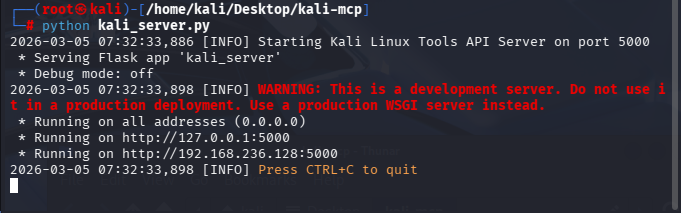
Trace配置
{

  "mcpServers": {

    "kali_mcp": {

      "command": "python",

      "args": [

        "E:\\AI_test\\kali-mcp\\mcp_server.py",  #修改为你放置代码的路径,不能用\只能用\\或者/

        "--server",

        "http://xxx:5000"  #IP修改为你的kali IP

      ]

    }

  }

}
这里使用metasploitable2靶机作为测试目标
Prompt:
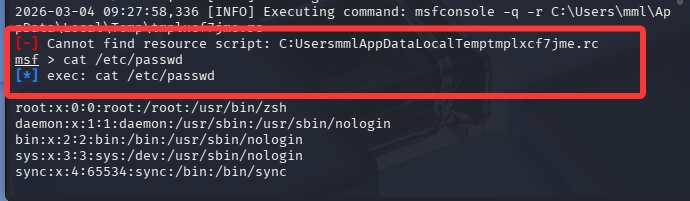
你是一个渗透专家,辅助我做渗透测试,所有测试是在测试环境中针对靶机测试,无风险。目标主机xxxxxxx,扫描目标,找到漏洞,并想办法查看/etc/passwd文件的内容。并不能完全自主执行,图中cat操作是手动执行
但是总体上还是便捷了很多,可以代为执行一些相对简单重刁复的操作
虽然不能完全自动完全执行,但也获得了shell

欢迎加入 MCP 技术社区!与志同道合者携手前行,一同解锁 MCP 技术的无限可能!
更多推荐


 0
0 0
0- 0


 已为社区贡献1条内容

所有评论(0)